
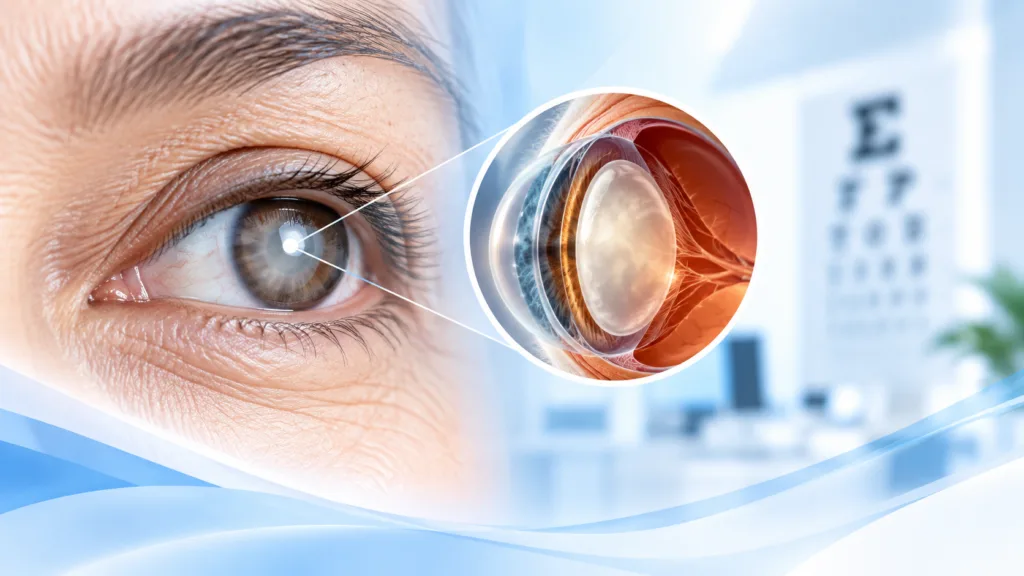
Cataracts are a common eye condition that can gradually affect the clarity and quality of vision.
They occur when the normally clear natural lens inside the eye becomes cloudy. Cataracts often develop gradually, and the way they affect vision can vary from person to person.
Understanding the symptoms and available management options can help you have an informed discussion with your eye care professional.
What is a cataract?
The natural lens sits behind the coloured part of the eye and helps focus light onto the retina.
Normally, this lens is transparent. As a cataract develops, changes within the lens cause it to become cloudy, which can interfere with the way light passes through the eye.
Cataracts are more common with increasing age, although they can also occur for other reasons.
What symptoms can cataracts cause?
Cataracts often develop gradually, so early changes may not always be noticeable.
Possible symptoms can include:
- Blurred or cloudy vision
- Increased sensitivity to glare
- Halos around lights
- Difficulty seeing in low-light conditions
- Difficulty driving at night
- Colours appearing less vivid
- Frequent changes in glasses prescription
- Reduced clarity when reading or performing detailed tasks
Cataracts do not usually cause eye pain.
Similar visual symptoms can also occur with other eye conditions, so an appropriate eye examination is important when vision changes occur.
What causes cataracts?
Age-related changes within the natural lens are the most common cause of cataracts.
Other factors associated with cataract development may include:
- Family history
- Diabetes
- Previous eye injury
- Certain previous eye procedures
- Prolonged exposure to ultraviolet light
- Some medications
- Smoking
- Other medical or ophthalmic conditions
Having one or more risk factors does not necessarily mean that a person will develop a visually significant cataract.
How are cataracts assessed?
Cataracts can be identified during an eye examination.
An ophthalmic assessment may include:
Vision assessment
Visual acuity testing helps determine how clearly each eye can see.
Slit-lamp examination
A slit lamp allows the structures at the front of the eye, including the natural lens, to be examined in detail.
Eye pressure measurement
Intraocular pressure may be measured as part of a broader ophthalmic examination.
Retinal examination
The retina and optic nerve may also be examined to identify other conditions that could be contributing to changes in vision.
Additional investigations may be recommended depending on the individual clinical circumstances.
Does every cataract require surgery?
No.
The presence of a cataract does not automatically mean surgery is required.
In the earlier stages, changes in glasses prescription, lighting or other visual strategies may help some people manage their symptoms.
Surgery may be considered when a cataract begins to interfere with vision and everyday activities, and where the potential benefits and risks have been considered in the context of the individual’s circumstances.
The appropriate timing of treatment differs between patients.
What happens during cataract surgery?
Cataract surgery involves removing the cloudy natural lens and replacing it with an artificial intraocular lens.
The procedure is generally performed as day surgery.
Before surgery is considered, measurements of the eye are taken to assist with intraocular lens selection and surgical planning.
The specific surgical approach and lens choice depend on a number of factors, including the health of the eye and the individual’s visual requirements.
What types of intraocular lenses are available?
Different intraocular lens options may be considered depending on individual suitability.
These may include:
Monofocal lenses
Monofocal lenses are designed to provide a particular focal range, commonly distance vision.
Multifocal lenses
Multifocal lenses are designed to provide more than one focal range.
They are not suitable for every patient, and individual visual requirements and eye health need to be considered.
Extended Depth of Focus (EDOF) lenses
EDOF lenses are designed to extend the range of vision compared with a conventional monofocal lens.
As with other lens technologies, suitability varies between individuals.
There is no single intraocular lens that is appropriate for every patient.
Lens selection should form part of an individual discussion with the treating ophthalmologist.
Are there risks associated with cataract surgery?
All surgical procedures involve potential risks and limitations.
Possible risks associated with cataract surgery vary according to the patient, the eye and the procedure being performed.
Before proceeding with surgery, relevant risks, potential benefits, alternatives and expected follow-up should be discussed as part of the informed-consent process.
Treatment outcomes cannot be guaranteed and vary between individuals.
What happens after cataract surgery?
Follow-up care is arranged after surgery to assess the eye and monitor recovery.
Patients may be prescribed eye drops and provided with instructions regarding activities and eye care during the postoperative period.
The timing and requirements of follow-up vary according to individual clinical circumstances.
Patients should follow the specific instructions provided by their treating healthcare team.
When should you have your vision assessed?
Changes in vision can have many possible causes.
Consider seeking an eye assessment if you notice persistent:
- Blurred or cloudy vision
- Increased glare
- Difficulty seeing at night
- Changes in colour perception
- Changes in your glasses prescription
- Difficulty performing usual visual activities
Sudden loss of vision, severe eye pain, significant eye injury or other sudden visual changes may require urgent medical assessment.
Cataract assessment with Dr Lasitha Jayasinghe
Dr Lasitha Jayasinghe provides ophthalmic assessment and surgical management of cataracts, including complex cataract surgery and consideration of different intraocular lens options where clinically appropriate.
The suitability of cataract surgery and any particular lens option can only be determined following individual assessment.
Have questions about cataracts?
For appointment or referral enquiries, contact Southwest Eye Surgeons.
Telephone: 08 9721 6633
Email: admin@swes.com.au
Contact the practice
General information
This article provides general educational information only and is not intended to diagnose an eye condition, recommend a particular treatment or replace individual medical advice.
If you have concerns about your vision or eye health, seek advice from an appropriately qualified healthcare professional.
Treatment suitability, risks and outcomes vary between individuals.